
Funktioniert Ihre Sämaschine tausend Stunden lang, ohne dass jemand ein Lager wechseln oder Fett nachfüllen muss? Keine echte Maschine kann das aushalten.
Diese Mod führt eine realistische Gerätewartung ein: Maschinen müssen geschmiert werden, verschleißen während des Einsatzes, können bei Vernachlässigung ausfallen und müssen mit Ersatzteilen, Zeit und Geld repariert werden.
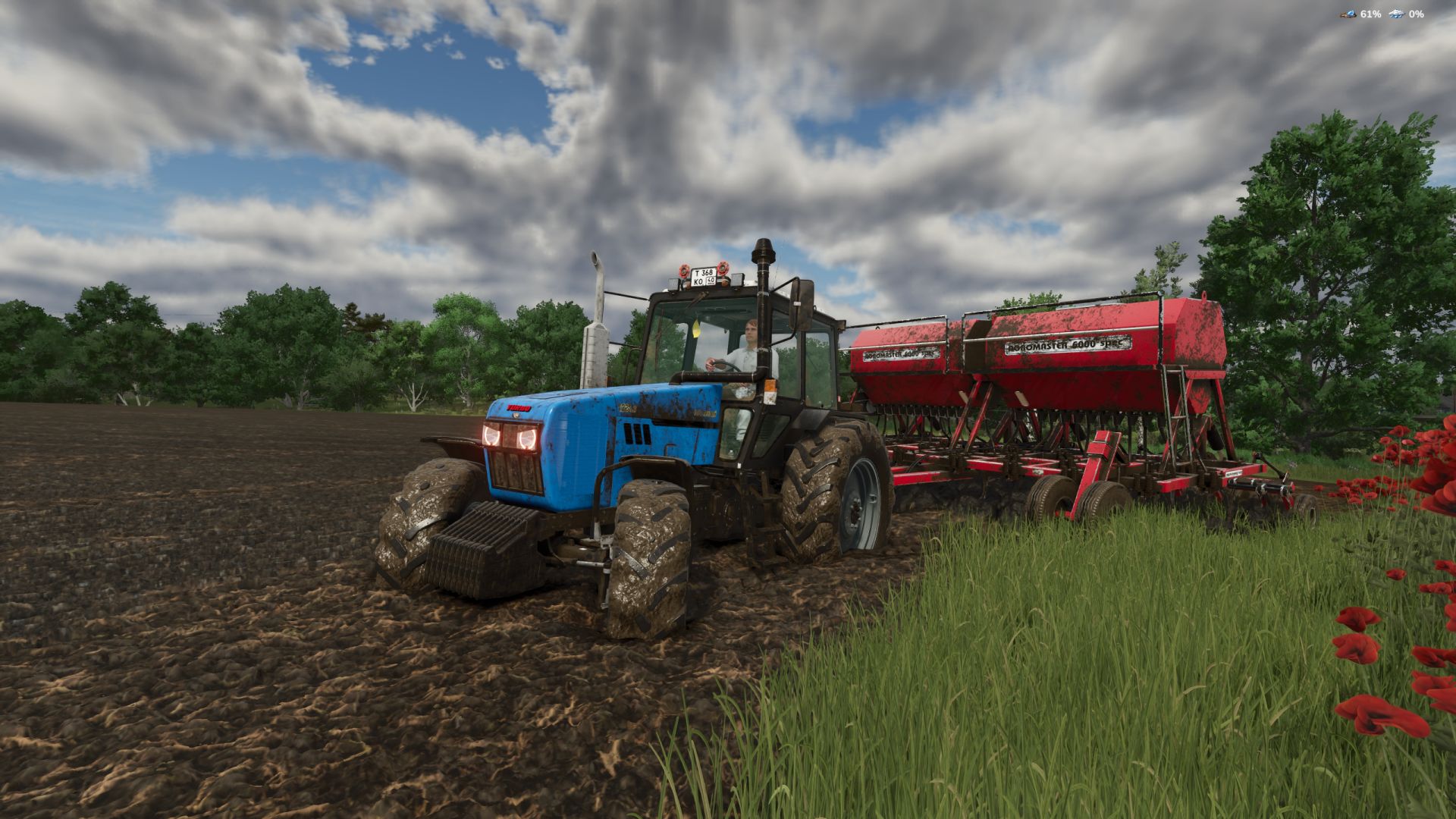
Sie funktioniert automatisch mit JEDEM gezogenen oder nicht motorisierten Gerät aus dem Basisspiel oder anderen Mods und erkennt dessen Komponenten. Keine Konfiguration erforderlich.
🛢️ REALISTISCHE SCHMIERUNG
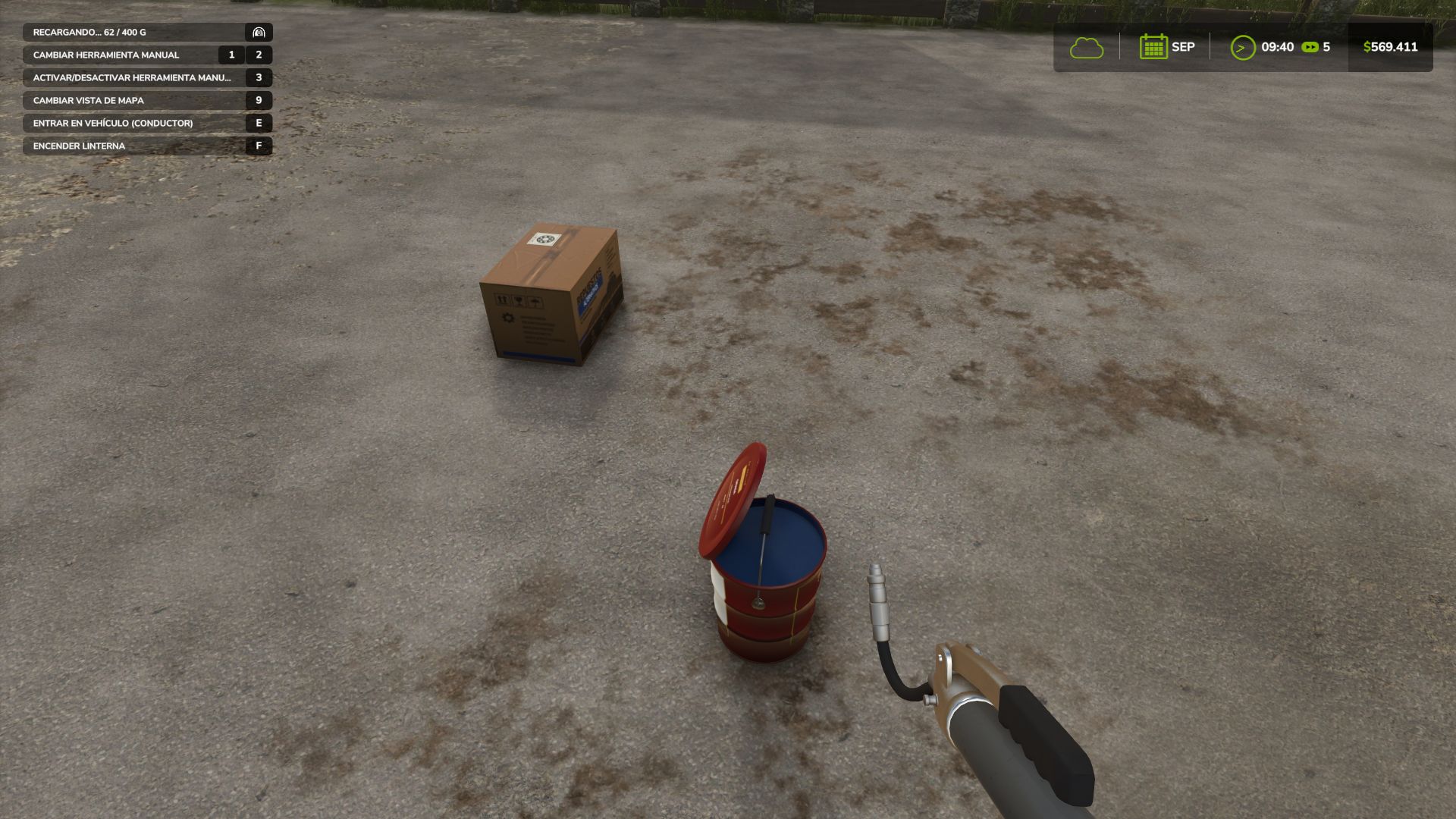
Verwende eine Fettpresse mit normalem oder hochwertigem Lithium-EP2-Fett. Hochwertiges Fett sorgt für längere Schmierintervalle.
Die Schmierung basiert auf den tatsächlichen Arbeitsstunden. Auch eine längere Einlagerung kann vor der Wiederinbetriebnahme eine Schmierung erforderlich machen.
⚙️ VERSCHLEISS NACH SYSTEM
Vier einzelne Systeme werden simuliert:
• Verschleißteile
• Lager und Getriebe
• Hydraulikkreisläufe
• Räder/Reifen
Jedes System hat seine eigene Lebensdauer. Der Verschleiß nimmt während des Betriebs zu und steigt schneller an, wenn die Maschine schmutzig ist oder die Schmierung abgelaufen ist. Der Zustand beeinflusst außerdem den normalen Maschinenverschleiß und den Wiederverkaufswert.
💥 REALISTISCHE AUSFÄLLE
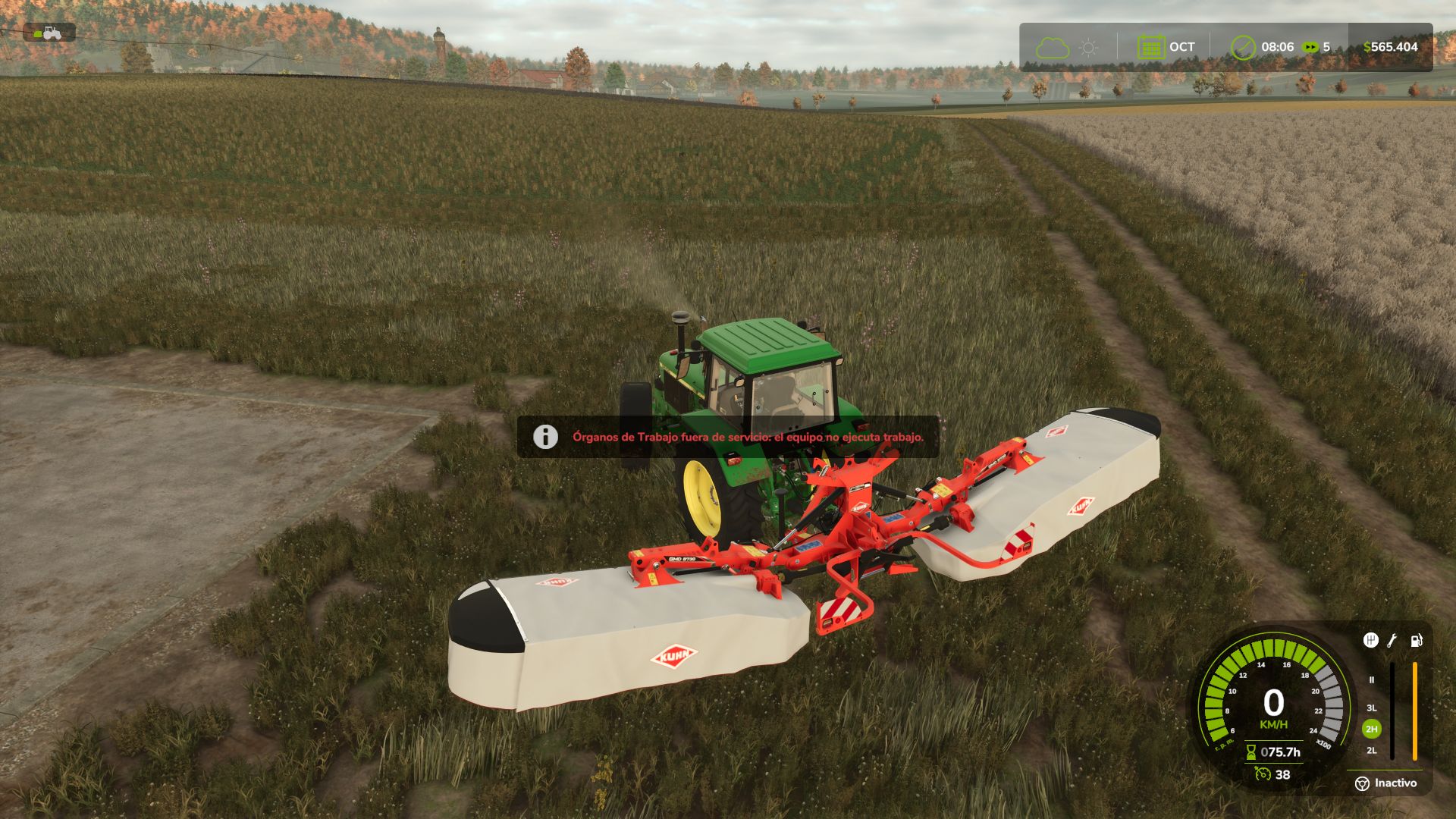
Maschinen können kleinere, schwere oder kritische Ausfälle erleiden. Je nach ausgefallenem Bauteil kann ein Gerät den Betrieb einstellen, sich nicht mehr absenken oder ausklappen lassen, mit reduzierter Geschwindigkeit arbeiten oder vollständig ausfallen.
Je stärker die Maschine verschlissen ist, desto größer ist das Ausfallrisiko.
🧰 REPARATUREN AUF DEM FELD
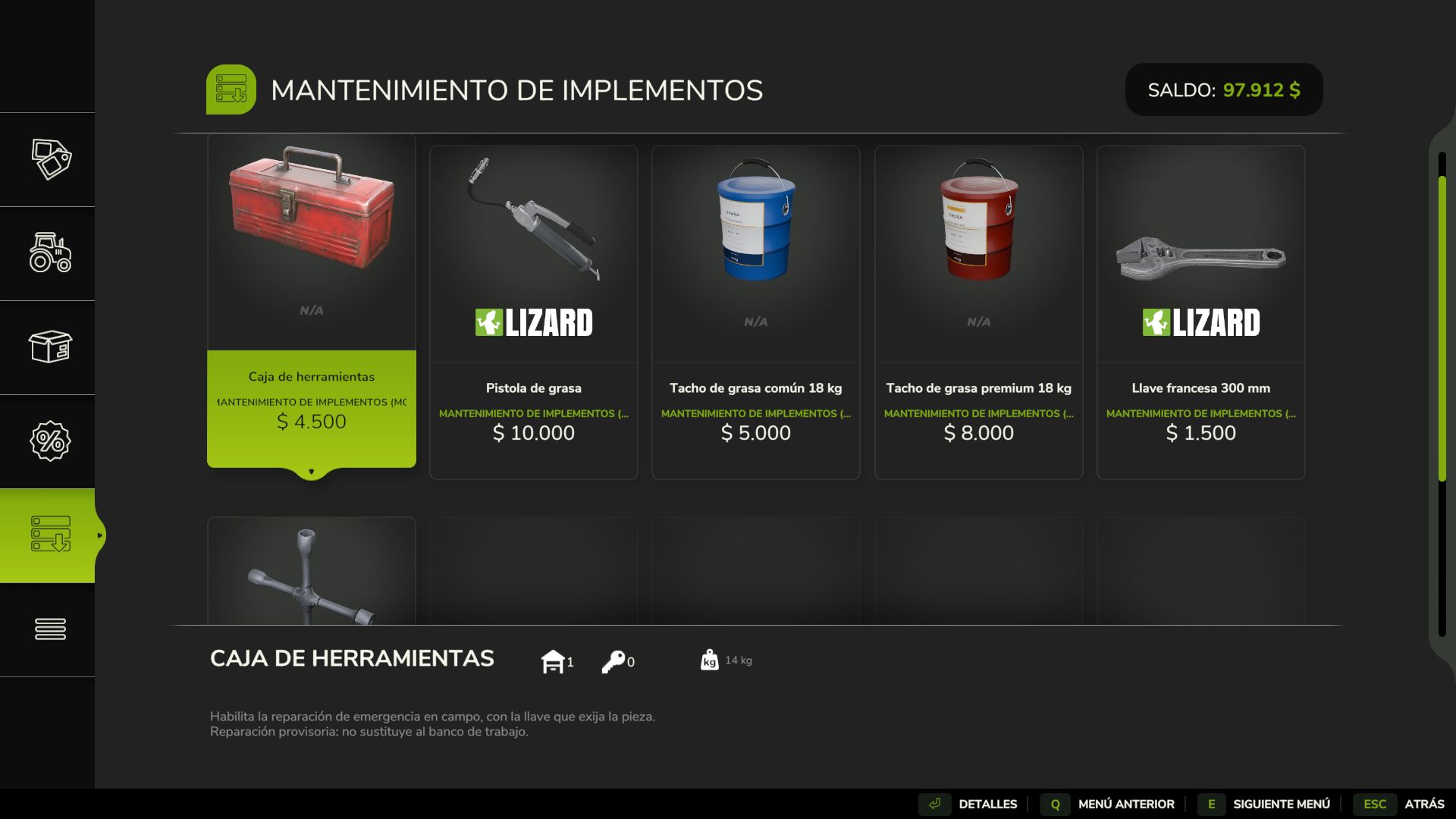
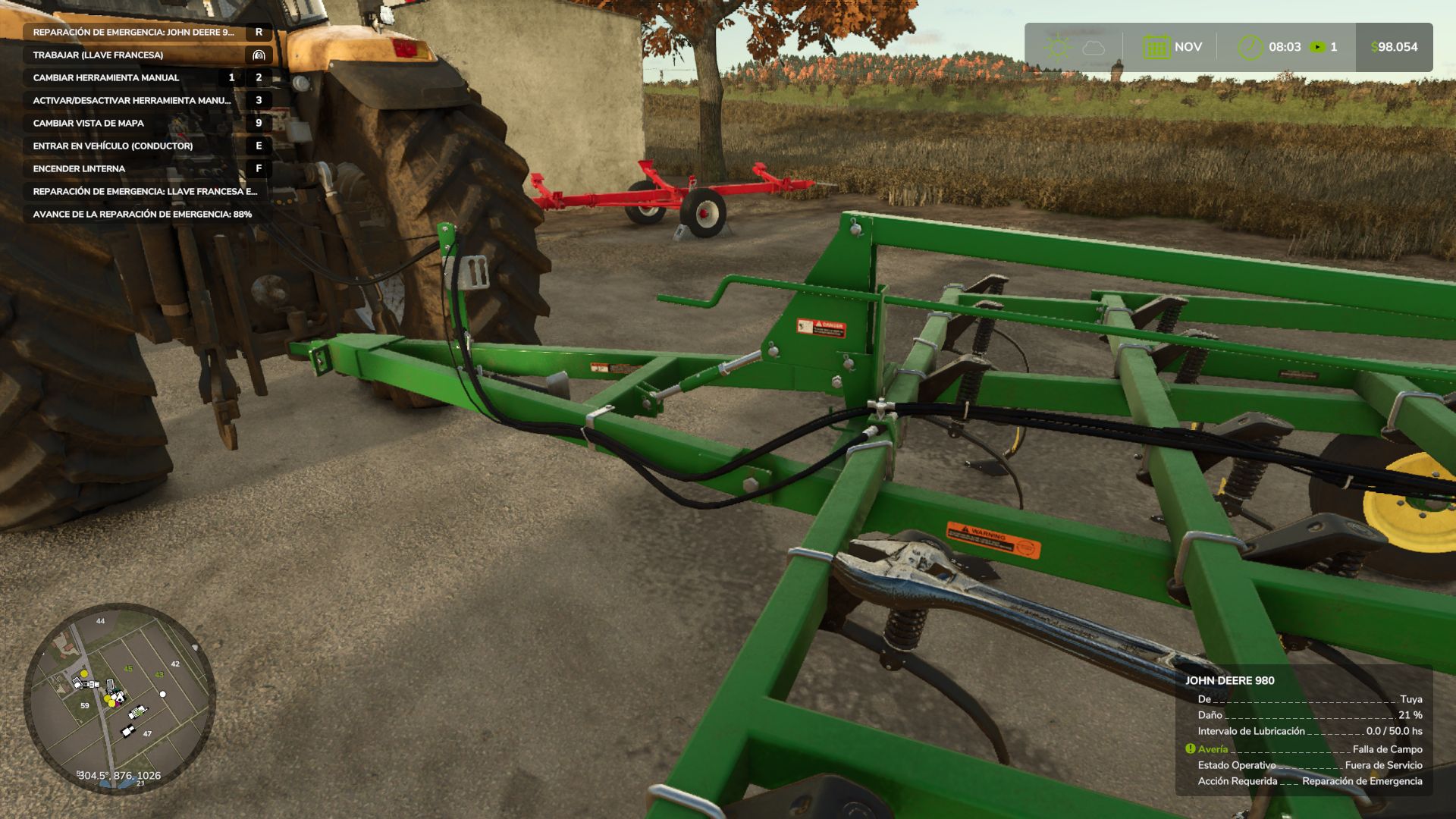
Ein Werkzeugkasten ermöglicht vorübergehende Notreparaturen schwerer Ausfälle direkt auf dem Feld, sodass du mit Einschränkungen weiterarbeiten kannst. Kritische Ausfälle erfordern eine Werkstatt.
🏭 DEINE EIGENE WERKSTATT
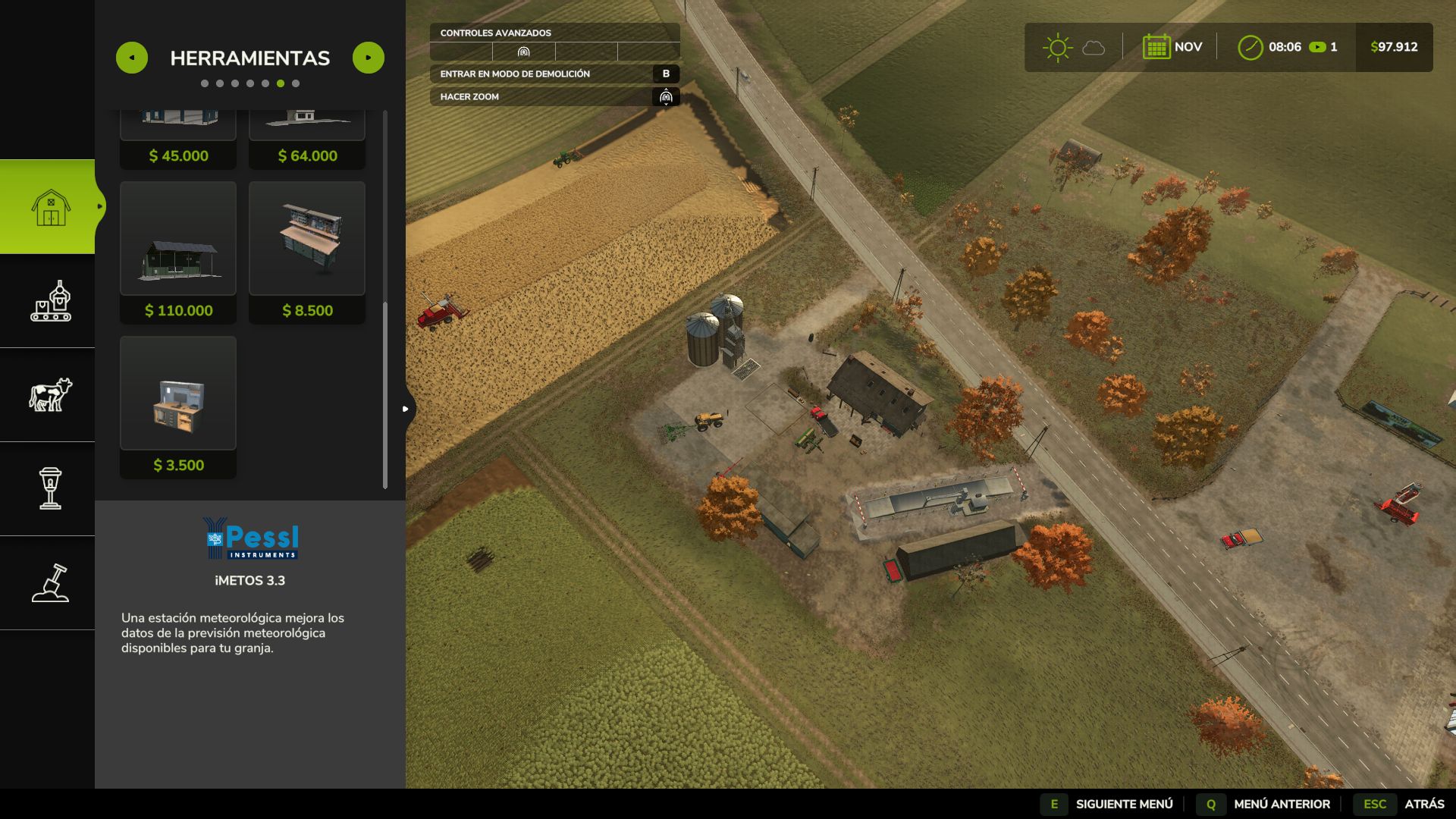
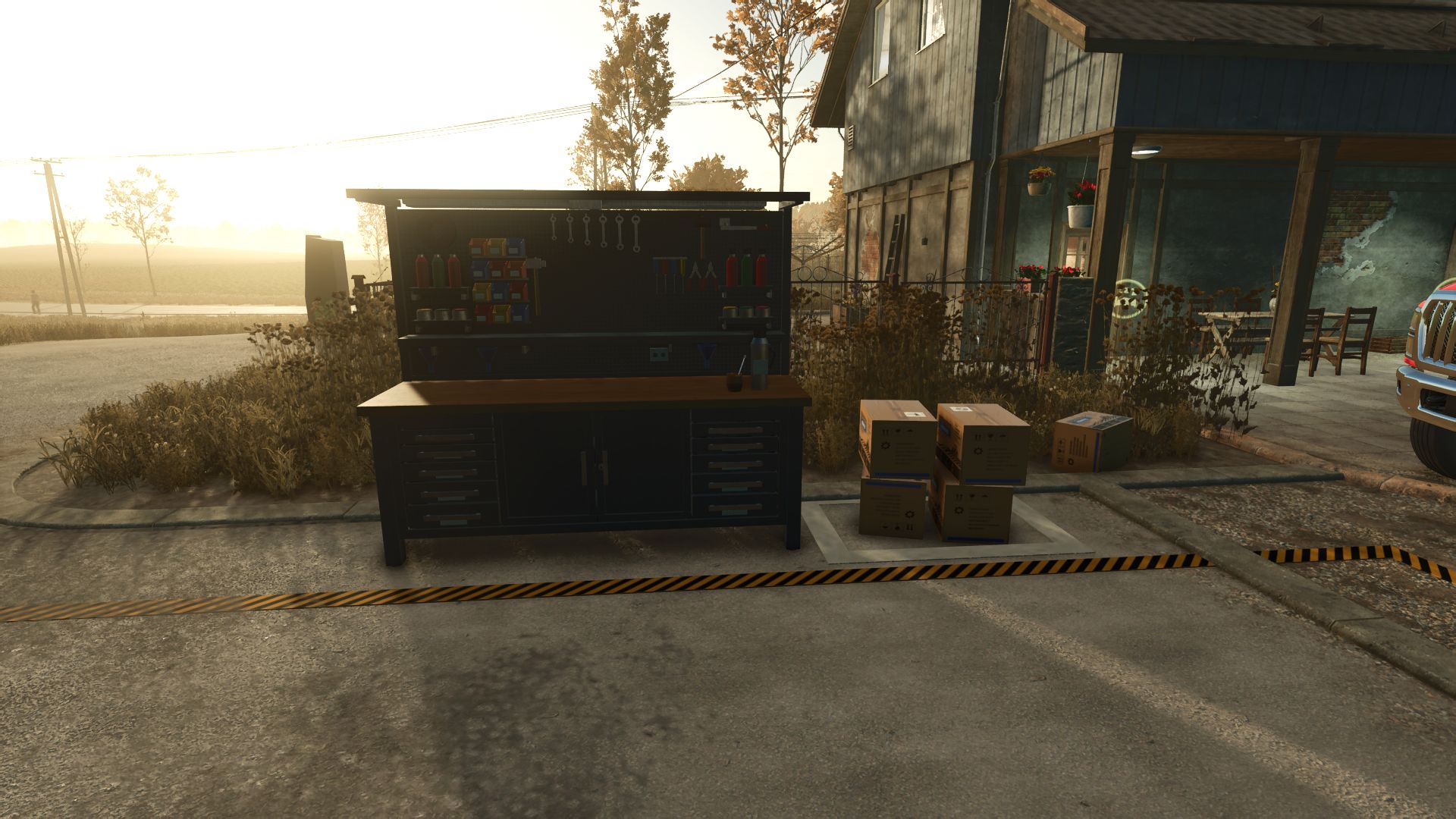
Platziere eine Werkbank mit einem Wartungsbereich auf deinem Hof, um Diagnosen und Reparaturen durchzuführen.
Reparaturen können den STANDARD- oder den schnelleren EXPRESS-Service nutzen und dauern von einigen Stunden bis zu mehreren Tagen. Die Reparatur eines Ausfalls beseitigt nicht den bereits vorhandenen Verschleiß der Maschine.
🔩 PHYSISCHE ERSATZTEILE
Die Diagnose zeigt die Betriebsstunden, den Verschleiß aller vier Systeme und die benötigten Ersatzteile an.
Für die Wartung werden physische Kits für Verschleißteile, Lager, Hydraulik oder Reifen benötigt. Für jede Maschine wird eine vollständige Wartungshistorie gespeichert.
🏷️ OEM ODER ZUBEHÖRTEILE
Ersatzteile sind als OEM- oder Zubehörteile erhältlich. Zubehörteile sind günstiger, haben jedoch eine kürzere Lebensdauer und können ein höheres Risiko für vorzeitige Ausfälle aufweisen.
🖥️ LIEFERANTENPORTAL
Verwende den Bestellcomputer, um Ersatzteile zu kaufen und deren Qualität und Menge auszuwählen. Die Lieferung dauert mehrere Tage; die Teile werden physisch zur Verwendung in deiner Werkstatt geliefert.
⚙️ FUNKTIONEN
• Automatische Unterstützung für Geräte aus dem Basisspiel und aus Mods
• Realistische Schmierung und Erfassung der Arbeitsstunden
• Vier unabhängige Verschleißsysteme
• Kleinere, schwere und kritische Ausfälle
• Notreparaturen auf dem Feld
• Werkstattdiagnose und -reparaturen
• Physische Ersatzteile und Lieferantenbestellungen
• OEM- und Zubehörteile
• Wartungshistorie und Unterstützung von Spielständen
• Kompatibel mit Multiplayer und Dedicated Server
• Fristen passen sich der Länge eines Spielmonats an
• Englisch, Spanisch, Deutsch, Französisch und Italienisch
• Kompatibel mit Agricultural Financial System (GN Realism)
Major update from the published 1.0.1.0. Everything below is new or changed; anything not mentioned remains unchanged.
🔧 **NEW HAND TOOLS**
· Adjustable wrench and cross wrench, available in the store (Tools), reusable.
· Mechanical work is now performed with the correct tool **IN HAND**: the tool animates, the ratchet sounds, and the progress bar advances while holding the trigger near the implement. Without the correct tool, the work pauses.
· The adjustable wrench is used for wear parts, bearings and hydraulics; the cross wrench is used for wheel nuts.
💲 **PRICES**
· Workbench: from $18,500 to $8,500 (daily maintenance from $25 to $10).
· Purchase Terminal: from $24,000 to $3,500 (daily maintenance from $30 to $5).
· Tools: adjustable wrench $1,500, cross wrench $1,900.
🏭 **WORKBENCH**
· New table-style diagnosis: one row per system with its pictogram, color-coded status, wear, installed part (OEM / Aftermarket), remaining service life, required parts and quantity, required tool, available stock and verdict.
· Maintenance service is performed in work stages, with the correct tool in hand and within 2.5 m of the implement, from any side. The stages take longer than before (actual work, not a single click).
· With the tool in hand and the implement in the service bay, the trigger can also start the service.
· Replacing the bearing kit leaves the assembly properly lubricated: the lubrication interval is reset to zero.
· More tolerant spare-parts supply zone.
· On-screen prompt when approaching the workbench: what to do with the bench (position implement, open diagnosis, cancel service).
🛢️ **GREASE GUN & GREASE TUB**
· The grease tub now has a LID: it can be opened and closed with its own action, and remains in the state you left it. With the lid closed, the grease gun cannot load, and the screen tells you so.
· New refilling system: aim at the tub opening, hold the trigger and grease is transferred gradually, with the amount shown on screen and the plunger rod coming out of the barrel in short pulls. The operation can be interrupted without losing the transferred amount.
· Greasing action reworked: the lever now actually opens and closes on each pump, with sound.
· On-screen prompts: refill available, refilling, lubricating, tub closed.
· When grease runs out, in addition to the warning you can hear the dry-metal squeal while continuing to work without lubrication.
💥 **BREAKDOWNS**
· Field failure (Level 1) is now a real breakdown: it has a functional consequence, can be repaired in the field and generates its own work order, with low cost and short duration.
· The consequence is always determined by the failed component, including critical failures.
· Hydraulic leak (field or serious failure): the implement can keep working, but folding, lifting and lowering operate at one quarter speed, with hissing and a warning. Ruptured hydraulic system (critical): no pressure, no folding, lifting or tipping.
· Progressive failure risk with wear, with no thresholds: a new part almost never fails, while a worn part is increasingly likely to fail.
· Spare-part reliability recalibrated: aftermarket parts have a higher chance of having a manufacturing defect, while original parts can also fail, but much less often.
· Each component has its own failure sound (metal breaking, bearing rattling, hose bursting, escaping air), while a critical failure adds a heavy impact sound and triggers the onboard warning.
· The message tells you what failed, what you lost, and what you can do.
🧰 **EMERGENCY REPAIR (TOOLBOX + TOOL)**
· No longer a single click: the toolbox must be placed next to the implement, the tool required by the failed component must be held in hand, and the repair takes about 12 seconds.
· Emergency repair availability is determined by the component and failure type, not severity alone: wear parts and hydraulics can always be repaired; bearings and wheels can be repaired up to serious failure; the chassis can never be repaired in the field.
· Operating margin depends on the component (2 to 4 hours). A second repair on the same failure lasts 60% as long, and there is no third repair.
· With an active emergency repair, the workbench recognizes the outstanding repair: it opens the work order for the pending definitive repair, showing the correct component, budget and estimated time.
🖥️ **PURCHASE TERMINAL**
· The catalog shows the pictogram for the selected system and the delivery time matches the time shown in the purchase-order list (same calculation, same format).
· On-screen prompt when approaching: open the supplier portal, orders in transit, or no workbench within range.
· Interface sound when opening the catalog and diagnosis.
📖 **INTEGRATED GUIDE**
· New 17-step guide (Alt+H, rebindable) explaining every component, tool, breakdown and consequence, using the actual values from the mod.
🖼️ **INTERFACE & TEXT**
· Implement information panel always shows damage, with highlighted alerts for lubrication, breakdowns, provisional repairs and depleted parts.
· Work order layout corrected (rows no longer overlap).
· Terminology unified across all five languages (workbench, purchase terminal, emergency repair, definitive repair, maintenance service, purchase order).
· German localization now includes correct accents.
✅ **1.0.1.0 FIXES RETAINED**
· The game's standard repair system does not apply to implements managed by the mod (clear warning shown to the player).
· Working speed limits are respected by the tractor (the harrow no longer runs at 32 km/h), with additional limits from breakdowns / worn tires / emergency repairs also respected while towing.
· With Agricultural Financial System installed, purchase orders use the available credit margin.
Compatible with savegames from 1.0.x: no new game required. Multiplayer and dedicated server supported.
Die standardmäßige Reparatur des Spiels (Werkstatt / Händler) gilt nicht mehr für Geräte, die von diesem Mod gewartet werden: Sie kostete Geld, ohne Schäden oder Verschleiß zu beheben. Eine eindeutige Meldung verweist nun auf die Werkbank.
Behoben: Geräte konnten schneller als ihre angegebene Arbeitsgeschwindigkeit arbeiten (z. B. eine Scheibenegge mit 32 km/h). Die Geschwindigkeitsbegrenzung gab nur einen der beiden vom Spiel erwarteten Werte zurück, weshalb der Traktor sie ignorierte. Die Geschwindigkeitsbegrenzungen durch Schäden, abgenutzte Reifen und den Patch gelten nun auch beim Ziehen.
Behoben: Wenn Agricultural Financial System installiert war, fiel die Prüfung der Kreditmarge für Teilebestellungen stillschweigend auf den Kassenbestand zurück. Nun wird die AFS-Marge verwendet.